
CBD vs. CBG for Sleep, Anxiety, or Pain
CBG costs more and sounds newer, but does it actually work better than CBD for sleep, anxiety, or pain? Here is what the research really shows.
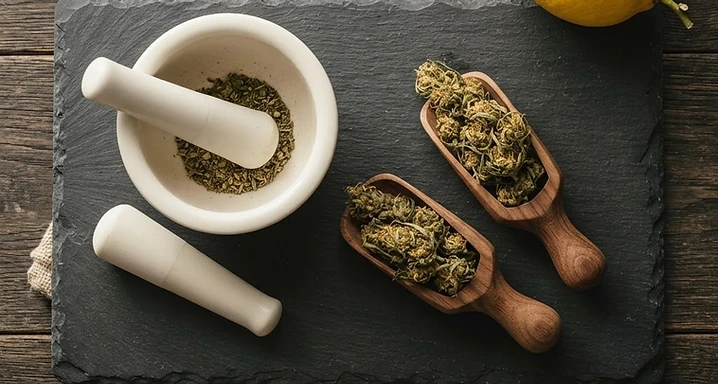
CBD vs. CBG for Sleep, Anxiety, or Pain
Scroll any CBD brand's site and you will see CBG lined up beside CBD, usually with a higher price tag and a much shorter explanation. Both come from hemp, both are non-intoxicating, and both get sold for many of the same reasons. They are not interchangeable, though, and the honest answer to "which one should I take?" depends on what you are trying to address and how much evidence you want behind the choice.
The short version: CBD has substantially more human research behind it, especially for anxiety. CBG has promising early laboratory and animal data plus a small number of human studies, and it costs more to produce. For sleep and pain, most of what people describe as results comes from CBD, often at the doses used in clinical trials. If you want the compound with the most evidence, start with CBD. If you have tried CBD at a real dose and found it underwhelming, CBG is a reasonable conversation to have with your healthcare provider, not a guaranteed upgrade.
What Actually Separates CBD from CBG
CBD (cannabidiol) and CBG (cannabigerol) are both cannabinoids produced by the cannabis plant, and neither one will intoxicate you the way THC does. The difference starts in the plant itself. CBG begins as CBGA, a precursor molecule that gets converted into other cannabinoids as the plant matures. By harvest time, most of that CBGA has been used up, which is why CBG typically makes up less than one percent of a mature hemp plant while CBD can account for fifteen percent or more.
That single fact explains a lot about the market. CBG is expensive because growers often have to harvest earlier, use specific genetics, or process far more plant material to isolate the same amount. A CBG product that costs twice as much as a comparable CBD product is not necessarily twice as good. It is often just harder to make.
How the Two Work Differently in the Body
Both compounds interact with the endocannabinoid system, the network of receptors and signaling molecules your body uses to regulate sleep, mood, appetite, and inflammation. They get there by different routes.
CBD works mostly indirectly. It does not bind strongly to the CB1 or CB2 receptors themselves. Instead it appears to slow the breakdown of your own endocannabinoids, like anandamide, and interacts with several other receptor systems including serotonin and vanilloid receptors. That indirect, multi-target profile is part of why CBD's effects show up across so many different concerns.
CBG binds more directly to CB1 and CB2 receptors, acting as a weak partial agonist. In laboratory studies it also shows activity at the alpha-2 adrenergic receptor and the TRP channels, which researchers find interesting for inflammation and pain signaling. This direct binding is the reason CBG gets described as "more targeted," but targeted in a petri dish and effective in a person are very different claims.
If you want the foundational picture of how these receptors work, our post on the endocannabinoid system covers it in plain language.
Which One Has Better Evidence for Sleep?
CBD has the stronger, though still imperfect, sleep evidence. A 2019 study of 72 adults presenting with anxiety or poor sleep found that 79 mg of CBD per day was associated with improved sleep scores in the first month, with effects that fluctuated over time. Smaller studies have found similar patterns, and a common thread in the literature is that CBD seems most useful for sleep problems that are driven by a busy mind rather than by a primary sleep disorder.
That distinction matters. If you are lying awake because you cannot stop replaying your day, CBD's effect on anxiety may be the mechanism. If you have sleep apnea or a circadian rhythm disorder, no cannabinoid fixes that.
CBG's sleep evidence is much earlier. There is preclinical work and anecdotal reporting, but no well-controlled human trial that establishes CBG as a sleep aid. Anyone selling CBG as "the sleep cannabinoid" is ahead of the science.
Which One Has Better Evidence for Anxiety?
This is CBD's clearest area. A widely cited 2019 study gave healthy adults with social anxiety 300 mg of CBD before a public speaking test and found significantly reduced anxiety compared with placebo. Another study using 79 mg per day in a clinical population reported sustained improvement in anxiety scores over three months. Reviews of the literature consistently describe CBD as promising for anxiety while calling for larger trials.
CBG's anxiety research is thin by comparison. There is early work suggesting CBG may influence GABA uptake and stress signaling in animal models, which is biologically plausible and worth watching. It is not the same as evidence in people.
Which One Has Better Evidence for Pain?
For pain, neither compound is a slam dunk, and anyone claiming otherwise is overselling. Reviews of CBD for chronic pain describe mixed results, with the strongest signals coming from neuropathic pain studies using fairly high doses. Many of the trials are small, short, and use different formulations, which makes drawing firm conclusions difficult.
CBG's pain research sits mostly in animal models of inflammatory and neuropathic pain, where it has shown measurable effects. Human data is scarce. For a cautious consumer, that means CBG is a hypothesis, not a treatment plan.
CBD vs. CBG at a Glance
| CBD | CBG | |
|---|---|---|
| Share of a mature hemp plant | Typically 10-20% in high-CBD varieties | Usually under 1% |
| Primary mechanism | Indirect: slows endocannabinoid breakdown, affects serotonin and other receptors | Direct, weak binding at CB1 and CB2 |
| Human research volume | Substantial and growing | Small and early |
| Best-supported use | Anxiety, and anxiety-driven sleep disruption | None established yet |
| Typical price | Moderate | Often two to three times higher per mg |
| Intoxicating | No | No |
Does Combining CBD and CBG Make Sense?
Manufacturers increasingly sell blends, and the marketing language usually invokes the entourage effect, the idea that cannabinoids work better together than alone. It is a reasonable hypothesis with real supporting data for some combinations, but the specific claim that CBD plus CBG outperforms either one alone has not been demonstrated in controlled human trials.
If you want to experiment with a blend, treat it the way you would treat any new product: one change at a time, a consistent dose, and a written note of what you noticed. If you change three things at once, you learn nothing.
What About Dogs and Cats?
The same logic applies to pets, with a stronger warning attached. Dogs have more cannabinoid receptors in their brains than humans do and are more sensitive to THC, which is why full-spectrum products with meaningful THC content are a poor choice for them. There is real veterinary research on CBD in dogs with osteoarthritis, and almost nothing on CBG in pets.
If you are considering a cannabinoid for your dog, start with our guide to CBD for dogs and read the label for both THC content and the milligram-per-milliliter concentration. For cats, our cat CBD page explains why the starting dose is lower and the evidence thinner still.
How to Buy Either One Without Wasting Money
Ignore the word "premium" and look for four things instead.
- A batch-specific certificate of analysis. Not a generic lab report on the website, but a document that matches the batch number on your bottle. Our COA Library explains what each panel should contain.
- Milligrams, not percentages. A thirty-milliliter bottle with thirty milligrams total is a very different product from the same bottle with three thousand milligrams. Our post on CBD potency walks through the math.
- A clear extraction and carrier story. CO2 extraction and a simple carrier like MCT oil is a clean baseline. Long ingredient lists with sweeteners and flavorings add variables.
- A return policy. Any brand confident in its product should let you send back an opened bottle.
If you would rather answer a few questions than read labels, our product match tool narrows the field to products we have already reviewed.
The Bottom Line
CBD has more research behind it, more available potency, and a lower price per milligram. CBG is genuinely interesting and worth following, but the current enthusiasm outruns the evidence. Start with a well-documented CBD product at a dose you can repeat, keep notes for a few weeks, and only then consider adding another cannabinoid to the experiment.
Frequently Asked Questions
Grow With GreenMan
Get our newest researched guides and product picks for people, dogs, and cats delivered to your inbox. No spam, ever.
Keep Reading
Does CBD Show Up on a Drug Test? What You Should Know
Curious if your CBD routine could impact a drug screening? Learn how testing works and why not all CBD products are created equal regarding THC content.
Read PostCBD Oil for Older Cats: Addressing Mobility and Comfort
Is your aging feline slowing down? Explore how to evaluate CBD oil for older cats to help support their daily comfort and mobility as they age.
Read Post